It’s that time of year in the Northern Hemisphere where the days are getting shorter and darker and it feels like things are wrapping up.
For some people it’s a very busy period and for other living beings—like the trees and bees—it’s a time for shedding and resting. For me, this moment feels rather nostalgic, as I will be covering the themes of fermentation, reflection and composti
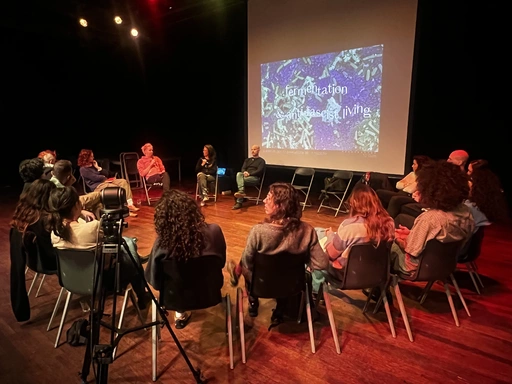
When things are changing, or need to change, it seems relevant to unpack and work with some of these adverbs—both practically and politically. We literally and metaphorically did that with fermentation during the two-part workshop Fermentation and Anti-Fascist Living, facilitated by Teresa Borasino (artist, researcher and activist for ecological justice).
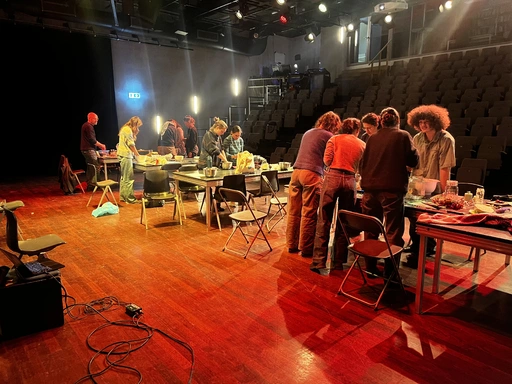
With a bag full of a variety of vegetables and a big glass jar in hand, I made my way to the Basecamp to join this much-anticipated workshop. The space was set up with seating in a circle, warm red lighting and rhythmic music playing in the background. Pen and paper in hand and waiting for the program to start, I listened to the Turkish woman next to me. She shared how it was a tradition around this time of year for her and her family to gather all the vegetables, which are in abundance, together with lots of jars, and to pickle using lemons or vinegar. Even before the workshop formally began, stories of preservation, collective labor and inherited knowledge were already circulating in the room. I’ve never pickled or fermented anything before, so I was thrilled to be there.
The Welcoming
“Welcoming and landing into the space has become a very important thing to me,” Teresa began. “We are going to be together for almost three hours, so let us take the time to allow our bodies to arrive in this space. Let the past be in the past and the future be in the future. Let us welcome our bodies—our microbial bodies, which hold more non-human cells than human ones—into this moment together. Let us welcome all of the emotions, different ability levels and limitations, different health conditions, different ways our brains work, different backgrounds. Welcome different ways of being activists, change makers, artists, cultural workers, and those who don’t identify as such. Welcome witches, Pagans, healers and those who don’t identify as those. Welcome all genders, ages, languages…”
Teresa continued with more welcomings, but I will leave space here for you to add other aspects of welcoming.
This was the most inclusive welcoming I’ve experienced thus far in my life. It set the tone for what followed: an understanding that both fermentation and anti-fascist living require intentional space-holding, patience and a refusal of purity. This was followed by an in-depth conversation about fascism and fermentation, led by Teresa and Coba, founder of nullRadio Kookpunt. Here are some snippets of the conversations that took place.
“What is the link between anti-fascism and fermentation?” someone asked.
“Fermentation is a collaborative practice between different bacteria and fungi/yeast—a symbiotic combination that is alive and vibrant,” Teresa shared. “Whereas fascism is about execution, death, elimination and purification.”
“Fascism today is expanding and growing across the world,” added Coba. “People don’t always see it as fascism due to the monopoly of mainstream media, which fuels capitalism. Not everyone can notice fascist actions unless they do their own research. And everyone lives in their own social media bubble, so it’s important to take the time to see how other people perceive things.”
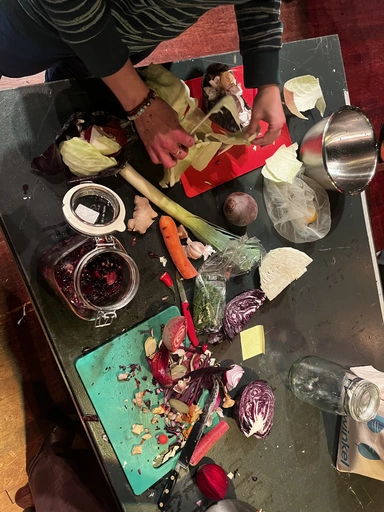
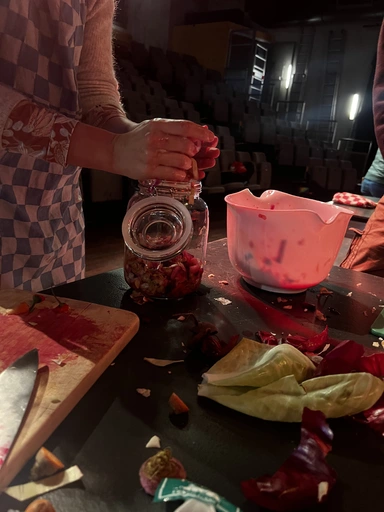
After several rounds of in-depth discussion, we rolled up our sleeves and started to cut, chop and smash cabbage, along with our personal preferences of vegetables such as carrots, beetroot, garlic and onions, squishing them into glass jars with measured amounts of salt. The theoretical conversations didn’t stop here—they softened and seeped into the practical work. As my hands worked, I began to think about what might need to be chopped, cut out or smashed out of my own life—things that subtly block the way for new connections or collaborations.
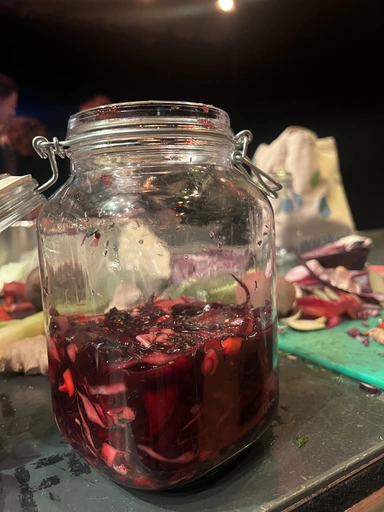
Now, as the large jar of well-smashed purple fermentation sits on my countertop, waiting to be burped each day, I continue to contemplate the subconscious habits that have been infused into our societies. What are the things we adhere to without questioning whether they are natural, necessary, or supportive of a healthy way of being together? Who are we actively welcoming into our lives and circles so that, together, we can ferment old ways into bubbling new futures?
And with these burped-up thoughts, I will leave you until the next blog.