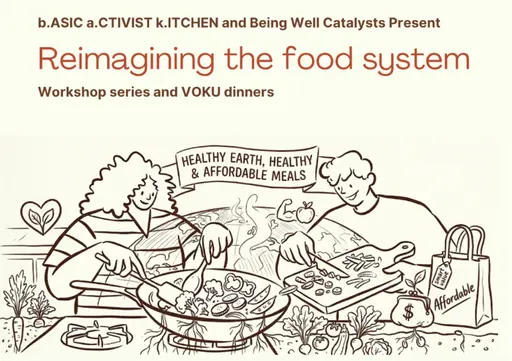
12 November 2026, 16:00 - 20:00
Open Kitchen Take-Over: Being Well Catalysts #2
Reimagining the Food System
organised by the Being Well Catalysts and the b.ASIC a.CTIVIST k.ITCHEN
16:00 - 18:00
workshop
18:00 - 20:00
VOKU & FreeShop
The workshop Circular Flows, Local Logistics & Operational Barriers is a co-creation workshop that addresses the fragmentation of local supply chains and navigates rigid institutional rules like HACCP compliance for hybrid social spaces.
Activity: Logistics & Compliance Hackathon. Designing a shared operational support model. Participants will co-create practical workflows for combining small-scale organic farmer logistics with community kitchen distribution.
The following strategic plan outlines a 3-part community dinner (VOKU) and interactive co-creation workshop series designed by the Being Well Catalysts' Wellbeing Kitchen initiative in partnership with the b.ASIC a.CTIVIST k.ITCHEN.
This series advocates a newly proposed Community Food Preventive Infrastructure (CFPI) framework alongside the plant-forward principles of the EAT-Lancet Commission and recent Dutch nutrition guidelines to finalize a healthy, sustainable, and affordable food system model for Utrecht.
The rationale for the Community Food Preventive Infrastructure (CFPI) stems from a persistent implementation gap between Utrecht's progressive political ambitions regarding public health and the highly unstable, disconnected reality in which grassroots food initiatives operate. While community kitchens generate substantial public, cultural, and environmental value, they are constrained by localized asymmetries, precarious funding, and complex regulatory compliance. Rather than treating food as a private market commodity, the CFPI provides a conceptual lens to reframe community-led systems as stable components of a prevention-oriented public infrastructure.
The primary aim of the CFPI is to serve as an intermediate governance framework that officially recognizes, coordinates, and supports the value produced by bottom-up initiatives. It acts as a distributed interface connecting municipal departments, local agroecological producers, healthcare providers, and community projects around shared long-term objectives. Operationally, the model strives to stabilize resource flows through mechanisms like a hybrid Food Health Fund, secure accessible physical spaces, streamline food safety compliance, and embed social prescribing networks into the neighbourhood infrastructure. By establishing these enabling conditions, the CFPI seeks to overcome individual behaviour-change limits, systematically bridging public health prevention, social inclusion, and resilient urban food system transformation.
Please register here:
www.bwcatalysts.com/agenda#h.jsekyi5q6bvn
